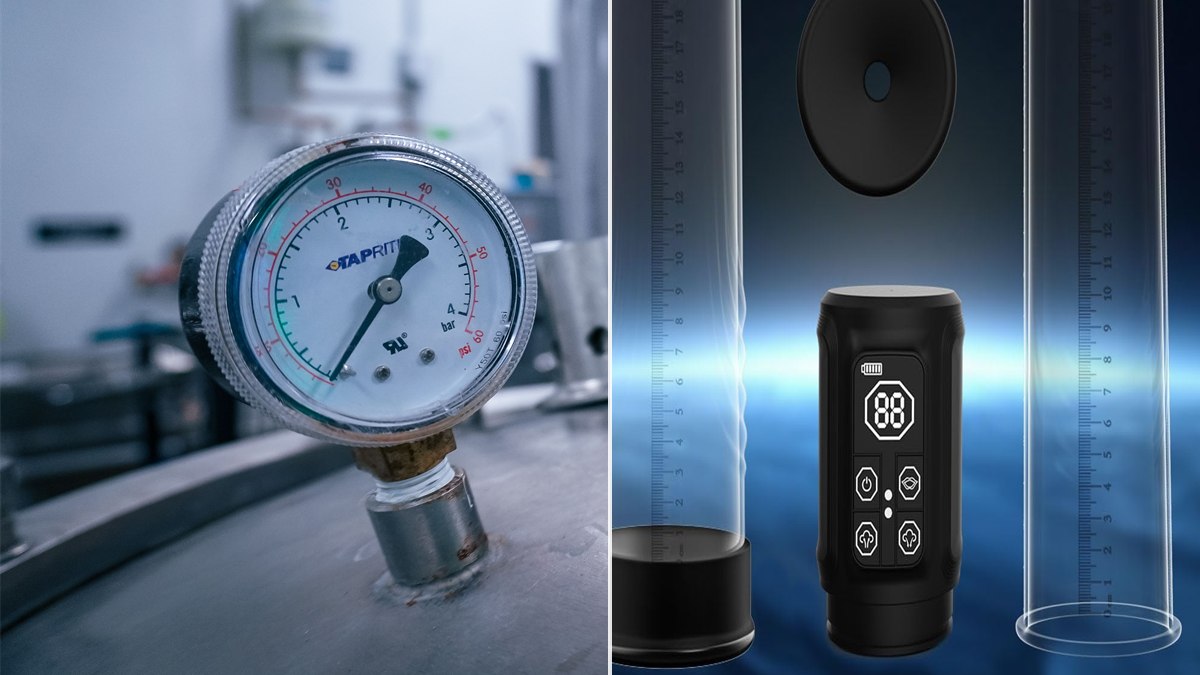
The short answer
A penis pump with a gauge gives you an additional device signal: a reading tied to the chamber pressure path. A pump without a gauge can still provide controlled vacuum when it has clear instructions, gradual operation, and an immediate release. The gauge is useful for repeatability and troubleshooting, but it cannot feel pain, detect pinched skin, confirm healthy color, or make an unsafe session safe. Choose by the complete control system, not by the dial alone.
This comparison has a different purpose from our gauge-not-moving diagnostic guide. That article helps when an existing indicator fails. This page helps a buyer decide whether pressure feedback belongs on the requirements list before choosing a device.
What a gauge actually adds
A real vacuum gauge is connected to the same pressure path as the chamber and reports a defined measurement. The value may appear on an analog dial or a digital display. To be useful, the manual must identify the units, the rest position, how the reading changes, and what the user should do when the display behaves unexpectedly.
The main benefit is not permission to chase a higher number. It is feedback. You can see whether the reading rises gradually, whether it stabilizes, whether it falls when the seal leaks, and whether it returns to rest after release. That can make setup more repeatable and diagnosis less dependent on guesswork.
Gauge vs no gauge at a glance
| Decision point | With a gauge | Without a gauge |
|---|---|---|
| Pressure feedback | Shows a defined chamber reading when the gauge and pressure path work correctly | Relies on the documented pump sequence, control response, tissue feedback, and release |
| Repeatability | Can help compare setup behavior across sessions on the same device | Depends more heavily on consistent assembly, fit, timing, and technique |
| Leak diagnosis | A falling or absent reading may help separate a seal leak from an indicator fault | Leaks are identified through loss of vacuum, sound, seal movement, and component tests |
| Complexity | Adds a sensor, dial, display, tube, or internal pathway that may need inspection | May have fewer feedback components to maintain |
| Safety | Useful only alongside a reachable release and body warning signs | Can be controlled when the manual and release design are clear |
| Best fit | Buyer who values visible feedback and documented units | Buyer who values a simpler mechanism and can follow a clear device-specific routine |
A gauge is feedback, not a safety ceiling
The body does not respond to a display in isolation. Seal size, chamber size, tissue position, sensation, medication, circulation, and the device's intended use all affect what happens in a session. A reading that appears ordinary can still accompany pinching, numbness, coldness, or uneven swelling. Those signs outrank the display.
Stop signs do not change when a gauge is present
Release immediately for pain, numbness, coldness, blue or dark color, bleeding, rapid swelling, or trapped tissue. Ask a clinician before use when you take anticoagulants, have a bleeding disorder or reduced sensation, or are recovering from pelvic, prostate, or penile surgery.
There is no universal pressure number that can be copied across every consumer pump. Units, calibration, chamber volume, seal behavior, and intended use differ. A number from a forum or another brand is not a substitute for the current manual for the exact device in front of you.
Not every display is a pressure gauge
Digital pump heads can display battery level, mode, timer, cycle, intensity setting, program status, or chamber vacuum. These are different signals. A buyer should not infer pressure measurement from the presence of digits or a screen. The product documentation should say what the value represents and how it is measured.
Before buying, look for four pieces of information: the name of the measurement, its units, the normal rest behavior, and the relationship between the display and the release control. If the page shows a dramatic number without defining it, the display has not yet provided useful evidence.
Analog and digital indicators have different failure clues
An analog dial can stick, sit away from zero, respond slowly, or be affected by a kinked or blocked tube. A digital display can lose power, freeze, show a mode rather than pressure, or receive a faulty sensor signal. Neither style is automatically more accurate simply because it looks clinical or modern.
Check whether the gauge is protected from impact and whether its pressure path can be inspected without unsafe disassembly. For a powered unit, confirm charging requirements and which parts must stay dry. The electric versus manual comparison covers motor, charging, noise, hand effort, and control separately from gauge choice.
How a gauge helps diagnose a seal problem
If vacuum forms and the reading then falls, the gauge can support a structured leak test. Start with the body-side seal, then check the release, valve, hose, connector, and cylinder. Change one variable at a time. A stable reading does not prove that fit is comfortable, but an unstable reading can show that the pressure path is changing.
Without a gauge, the same test relies on felt loss of vacuum, a rising seal edge, hissing, connector movement, or failure to maintain the chamber state. The not-holding-vacuum guide gives a component order that works for both categories.
Release design matters more than the dial
A visible reading is not useful if pressure cannot be released immediately. The release should remain reachable in the normal position, work without power, and be clearly distinguished from the control that increases vacuum. The manual should explain what the gauge does during release and what a failure to return to rest means.
Test the release according to the manual before body use. Do not block it, modify it, or continue when it sticks. If a powered pump depends on a screen or motor for normal operation, confirm whether a separate mechanical release remains available during a battery or software fault.
When a gauge is worth prioritizing
- You want a documented reading for consistent setup on the same device.
- You prefer a visible clue when comparing seal, valve, hose, or connector behavior.
- The manual clearly defines units, rest behavior, release behavior, and fault states.
- The gauge can be protected, cleaned, and serviced without exposing unapproved parts to water.
- Replacement gauges, sensors, hoses, or supported service are realistically available.
A gauge is less valuable when the display is unexplained, the release is hard to reach, the product has no current manual, or the seller uses the reading as proof of an outcome the device has not established.
When a no-gauge pump can be the better fit
A simpler mechanism may be easier to pack, clean, and inspect. A no-gauge pump can be a reasonable choice when its control moves gradually, the release is immediate, assembly is unambiguous, and the instructions provide a conservative sequence. Fewer parts can also mean fewer failure points.
That simplicity does not remove the need for technique. Fit and tissue feedback become even more important. Confirm the cylinder and seal dimensions rather than choosing by a small, medium, or large label alone. The cylinder and body-side seal guide explains which measurements matter.
Five checks before buying either type
- Define the intended use. A medical vacuum erection device workflow is not automatically the same as a consumer training pump.
- Find the current manual. Confirm assembly, pressure feedback, release, cleaning, contraindications, and storage.
- Verify the complete kit. Identify the cylinder, body-side seals, vacuum source, release, charger or hose, and maintenance parts.
- Check replacement support. A proprietary sensor or seal is useful only while the correct replacement remains available.
- Calculate delivered cost. Include shipping, tax, required lubricant, replacement seals, chargers, and other maintenance items.
For another category decision, the water versus air comparison separates the session environment from the feedback mechanism.
Evidence and intended use still set the boundary
NIDDK and NHS describe vacuum devices as options for erectile dysfunction, and 21 CFR 876.5020 addresses external penile rigidity devices. Those sources support a device category and medical use context. They do not make every online pump equivalent, and they do not turn a gauge reading into proof of permanent enlargement.
Match claims to the exact device and goal. A gauge may improve visibility and repeatability. It does not replace clinical diagnosis, establish the regulatory status of a particular retail product, or predict a permanent result.
TopMan product disclosure
The current TopMan Pro Extender Pump System costs $199 and includes one clear cylinder, three S/M/L body-side seals, controlled pressure release, a maintenance kit, and the complete Jelqing Mastery Course with 13 topic modules and 34 private lessons. Before treating any display or indicator as a pressure gauge, verify its meaning, units, and behavior in the current product instructions.
Bottom line
Choose a penis pump with a gauge when the reading is defined, the pressure path is documented, and visible feedback will improve your setup and troubleshooting. Choose without one when a simpler mechanism, clear instructions, gradual control, and immediate release fit your routine better. In either case, the release, fit, body warning signs, maintainable parts, and honest intended-use evidence matter more than the presence of a dial.
Frequently asked questions
Is a penis pump with a gauge safer than one without?
A gauge adds feedback, but it is not an automatic safety system. Safe use still depends on the exact instructions, a reliable release, gradual control, correct fit, and immediate attention to pain, numbness, color, temperature, and swelling.
What should a penis pump gauge show?
The manual should define the units, rest position, normal response, and any allowed operating range for that exact model. Do not copy a number from another device because gauges, chamber sizes, seals, and intended uses differ.
Can I use a penis pump if the gauge stays at zero?
Stop and release first. A zero reading can reflect a leak, blocked pressure path, disconnected tube, stuck indicator, or a display problem. Follow a component-by-component test instead of creating more vacuum.
Is a digital display the same as a pressure gauge?
Only when the manufacturer states that the displayed value measures chamber vacuum and explains the units and behavior. A timer, battery indicator, mode number, or program level is not automatically a pressure reading.
Does a gauge prove a penis pump will create permanent enlargement?
No. A gauge reports a device variable; it does not establish a permanent outcome. Vacuum has established erectile-function uses and creates temporary expansion, while evidence does not support a predictable permanent-enlargement promise from a consumer gauge reading.
Sources and further reading
- National Institute of Diabetes and Digestive and Kidney Diseases. Treatment for erectile dysfunction.
- Electronic Code of Federal Regulations. 21 CFR 876.5020 - External penile rigidity devices.
- National Health Service. Erectile dysfunction: causes and treatments.
- The Ohio State University Wexner Medical Center. Patient education on vacuum erection device use.
Compare the complete control system
Review the clear cylinder, three S/M/L body-side seals, controlled release, maintenance kit, included course, and current $199 price.
Explore the pump system