The short answer
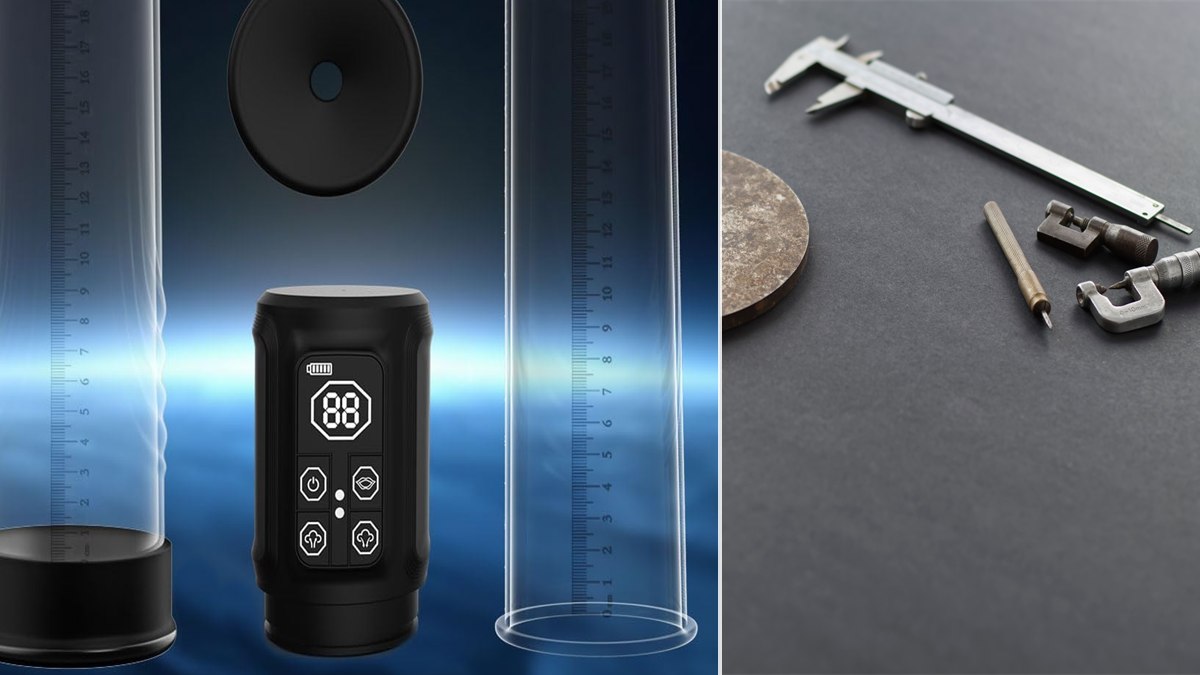
A functional penis pump kit needs a compatible cylinder, a body-side seal, a vacuum source, and an immediate release, supported by instructions for assembly, fit, use, cleaning, and storage. Hoses, gauges, chargers, adapters, lubricant, constriction rings, spare seals, and maintenance tools depend on the design and intended use. The most complete-looking box is not automatically the best kit; every included part must have a defined job and remain replaceable.
Product pages often show a cylinder and a pump head while leaving the rest of the package vague. That makes it difficult to compare delivered value or know whether a required seal, charger, hose, or cleaning item must be bought separately. Use this checklist before checkout and compare the written package list with the current manual.
The four-part functional chain
Every pump design needs four functions, even when several are combined into one housing. The cylinder creates the chamber. The body-side seal closes the chamber against the body. The vacuum source removes air or water from the chamber. The release returns the chamber toward normal pressure. If any link is missing, incompatible, damaged, or poorly documented, the kit is not ready for use.
An integrated powered head may combine the vacuum source, control, display, valve, and release. A manual setup may separate those jobs into a bulb, hand pump, hose, gauge, and valve. Count functions, not just objects in the photograph.
Penis pump kit checklist at a glance
| Kit item | What to verify | Common omission or confusion |
|---|---|---|
| Cylinder | Internal dimensions, usable length, markings, condition, and compatibility | External size or generic small/large labels instead of internal dimensions |
| Body-side seal | Opening size, flange contact, orientation, and exact cylinder fit | Confused with a constriction ring |
| Vacuum source | Manual or powered operation, gradual control, power needs, and service | Motor or bulb shown without its required connector |
| Release | Immediate access, power-independent operation, and manual instructions | Release control not identified in the package list |
| Hose or adapter | Correct length, connector type, routing, and replacement availability | Proprietary fitting sold separately |
| Gauge or indicator | Meaning, units, rest behavior, and pressure-path connection | Timer or mode display presented as pressure feedback |
| Power accessories | Charger, cable, plug, battery type, and water-exposure limits | Uncommon cable or battery not included |
| Maintenance items | Approved cleaning tools, drying method, and storage | Generic cleaner that may damage seals |
| Spares | Seal, valve, gasket, filter, hose, or connector compatibility | Decorative extras instead of wear parts |
| Instructions | Current model, intended use, assembly, release, stop signs, and support | One-page marketing leaflet with no operating detail |
1. Cylinder: measure the usable chamber
The cylinder should have published internal diameter and usable internal length. External dimensions can exaggerate usable space because walls, taper, base hardware, and the pump head occupy room. A ruler printed on the cylinder can help with consistent positioning, but markings do not prove the internal dimensions or an outcome.
Inspect for cracks, chips, clouding, distortion, sharp edges, or loose joints before use. A damaged cylinder is not repaired by adding lubricant or more vacuum. For sizing details, use the cylinder and body-side seal guide.
2. Body-side seals: fit and compatibility matter
The body-side seal closes the cylinder at the body. It may be a flange, sleeve, gasket, cone, or interchangeable opening. A kit with several sizes is useful only when the dimensions and compatibility are documented. Three accessories labeled small, medium, and large do not help if the seller does not explain what changes between them.
The best fit is not automatically the tightest. The goal is stable contact at gentle vacuum without sharp pressure, pinched skin, numbness, or surrounding tissue being pulled into the chamber. Replacement seals should be identifiable by model rather than by appearance alone.
3. Vacuum source: manual, powered, water, or air
The package may use a hand lever, squeeze bulb, powered head, or water-based mechanism. That choice affects hand effort, noise, charging, portability, leak testing, and cleaning. It does not by itself establish safety or effectiveness.
Compare the mechanism separately with the electric versus manual guide and the water versus air guide. A complete kit listing should say which mechanism is actually supplied, not merely which versions appear in a gallery.
4. Immediate release: the non-negotiable control
The release should remain reachable during normal use and should not depend entirely on battery power. The instructions must identify it clearly and explain how the chamber returns toward normal pressure. A button that pauses a motor is not automatically a release valve.
Test the release according to the manual before body use. Do not block, modify, or substitute it. A kit that describes how to create vacuum but does not explain immediate release has omitted a critical part of the operating sequence.
5. Gauge or display: verify what it measures
A gauge can add repeatable feedback and help diagnose leaks. It also adds a sensor, tube, dial, display, or internal pathway that can fail. The manual should define the units and rest behavior. Digits may represent time, battery, mode, or program level rather than chamber vacuum.
The gauge versus no-gauge comparison explains when visible feedback is worth the extra complexity. If an existing gauge stays at zero or fails to return to rest, stop and follow the gauge diagnostic sequence.
6. Hoses, valves, connectors, and adapters
Separate pump components need a pressure path. Confirm whether the hose and every adapter are included, how each connector locks, and whether replacements are available. A visually similar hose may have the wrong diameter, stiffness, seal, or fitting.
These small parts are common leak points. Residue, a bent connector, a loose valve, or a cracked hose can prevent vacuum from forming or make it fall. The vacuum troubleshooting guide provides a controlled test order without encouraging extra pump cycles.
7. Charger, cable, batteries, and dry zones
A powered kit should name the charging method, cable, battery requirements, expected indicator behavior, and replacement route. Confirm whether the charging accessory is in the box and whether the plug is practical in the delivery country.
The manual must also identify parts that cannot be immersed. A water-resistant claim is not permission to submerge a motor, display, charging port, gauge, or hose. Store cables with the device so a generic replacement is not used by guesswork.
8. Lubricant and cleaning supplies
Some body-side seals use a small amount of compatible water-based lubricant. The exact type and amount are device-specific. A kit may include a sample, list an approved type, or require a separate purchase. Do not use numbing products to tolerate more pressure, and do not assume petroleum products are compatible with the seal.
Cleaning instructions should separate washable skin-contact parts from valves, hoses, gauges, and powered parts that must stay dry. The part-by-part cleaning guide covers washing, drying, inspection, and storage.
9. Spare parts and maintenance value
A spare seal, gasket, valve, filter, or connector can be more useful than a decorative bag. Ask which parts normally wear, how they are identified, and whether replacements remain available from the seller. A low initial price can become expensive when the first damaged seal requires replacing the entire device.
A maintenance kit should have a defined purpose. Brushes, cloths, or tools should match the approved cleaning method. Oils, solvents, adhesives, and improvised sealants should not be added unless the current manufacturer instructions specifically require them.
10. Constriction rings are a separate decision
A body-side seal creates the vacuum boundary at the cylinder. A constriction ring is intended to help retain an erection after vacuum creates one in a documented medical VED workflow. The parts may both look circular, but they are not interchangeable.
Not every consumer pump kit includes or requires a constriction ring. Do not improvise one from a base seal or choose a ring by appearance. The base seal versus constriction ring guide explains the roles and safety boundaries.
11. Instructions, intended use, and support
A complete kit includes knowledge, not just hardware. The current manual should identify the model, intended use, assembly order, controls, release, cleaning, contraindications, stop signs, storage, and support route. Confirm that the document matches the exact version being sold.
NIDDK and NHS describe vacuum devices as options for erectile dysfunction, and 21 CFR 876.5020 addresses external penile rigidity devices. That category context does not establish the status, evidence, or intended use of every retail pump. Claims must be matched to the exact product and workflow.
12. Delivered price and package verification
Compare the final delivered kit, not the hero price. Add shipping, tax, required lubricant, missing seals, charger or batteries, replacement parts, and any support subscription. Then subtract nothing for a bonus unless it is actually included and useful to you.
Before checkout, capture the written package list
Confirm the exact cylinder count, seal sizes, vacuum source, release, hose or charger, maintenance items, instructions, included training, delivery terms, and return policy. Product gallery images can show accessories from another bundle, so the written order summary is the stronger reference.
Red flags in an incomplete kit listing
- No internal cylinder dimensions or seal-opening measurements.
- No immediate release identified in the manual.
- A display is shown without saying what it measures.
- Required hose, charger, adapter, or lubricant is not in the written package list.
- No replacement route for seals, valves, or proprietary connectors.
- Cleaning language says everything is washable without component limits.
- Permanent results are promised from hardware appearance or pressure claims alone.
Hardware completeness does not remove body stop signs
Release immediately for pain, numbness, coldness, blue or dark color, bleeding, rapid swelling, or trapped tissue. Ask a clinician before use when you take anticoagulants, have a bleeding disorder or reduced sensation, or are recovering from pelvic, prostate, or penile surgery.
TopMan package disclosure
The current TopMan Pro Extender Pump System costs $199 and includes one clear cylinder, three S/M/L body-side seals, controlled pressure release, a maintenance kit, and the complete Jelqing Mastery Course with 13 topic modules and 34 private lessons. Use the current product page and instructions to verify every operational detail before use.
Bottom line
A good penis pump kit is a documented system, not a pile of accessories. Verify the four-part functional chain first: cylinder, body-side seal, vacuum source, and immediate release. Then confirm the indicator, hose, charger, maintenance items, spares, instructions, and replacement support that the exact design requires. Compare delivered packages in writing, and treat fit, release, maintainability, and honest intended-use evidence as more important than box size.
Frequently asked questions
What should come in a penis pump kit?
At minimum, the package needs a compatible cylinder, body-side seal, vacuum source, and immediate release, plus model-specific instructions. Depending on the design, it may also need a hose, charger, lubricant guidance, cleaning tools, spare seals, or adapters.
Does every penis pump kit include a constriction ring?
No. A body-side cylinder seal and a constriction ring have different jobs. Some medical VED kits include a documented constriction-ring workflow for retaining an erection, while many consumer pump kits do not. Never substitute one part for the other.
Do I need several penis pump seal sizes?
Multiple documented seal options can help fit, but labels alone are not enough. Verify the actual opening dimensions, compatibility with the cylinder, and whether the package contains different body-side seals or merely different accessories.
Is lubricant normally included with a penis pump?
Some kits include a small lubricant, while others specify a compatible type without supplying it. Use only products allowed by the current manual, and do not assume petroleum or numbing products are compatible.
How can I compare the real price of two penis pump kits?
Compare delivered cost, not only the headline price. Include shipping, tax, required seals, charger or batteries, lubricant, cleaning items, replacement parts, warranty terms, and any training or support that is actually included.
Sources and further reading
- National Institute of Diabetes and Digestive and Kidney Diseases. Treatment for erectile dysfunction.
- Electronic Code of Federal Regulations. 21 CFR 876.5020 - External penile rigidity devices.
- National Health Service. Erectile dysfunction: causes and treatments.
- The Ohio State University Wexner Medical Center. Patient education on vacuum erection device use.
Check the package in writing
Review the TopMan system's clear cylinder, three S/M/L body-side seals, controlled release, maintenance kit, included course, and current $199 price.
See the complete pump system